


Electrical Conductivity
Electrical conductivity, expressed in Siemens per meter (S/m), is a measure for the ability of a fluid or electrolyte solution to conduct electricity. Conductivity is the inverse of electrical resistance (Ω.m), the ability to resist flow of electricity or current.
In a water-based solution, such as an antifreeze coolant, electrical conduction happens by the movement of electrically charged atomic species or ions moving in an applied electrical field. Therefore, conductivity is dependant of multiple (interdependent) factors:
-
Ionic size and charge:
Ions have a different ionic radius and charge. Generally, ions with higher charge and smaller ionic size cause higher electrical conductivity as these are able to move faster through the solvent. In a solvent, however, ions attract solvent molecules resulting in a solvation shell or, in water, hydration shell, which size is called Stokes radius (α) (Figure 1). This Stokes radius is the effective radius of the moving ion including any molecules of water or other solvent that move with it. Higher charge density of an ion (charge over ionic radius) causes more solvent molecules to be attracted. In turn, this causes theoretically smaller ions like Na+ to witness more drag during ionic movement in water than larger ion such as K+. As a result of its smaller hydrodynamic size K+ thus causes higher electrical conductivities than Na+. Every type of migrating ion has a specific molar conductivity (λ0) , that can be determined at infinitely low concentration (Table 1)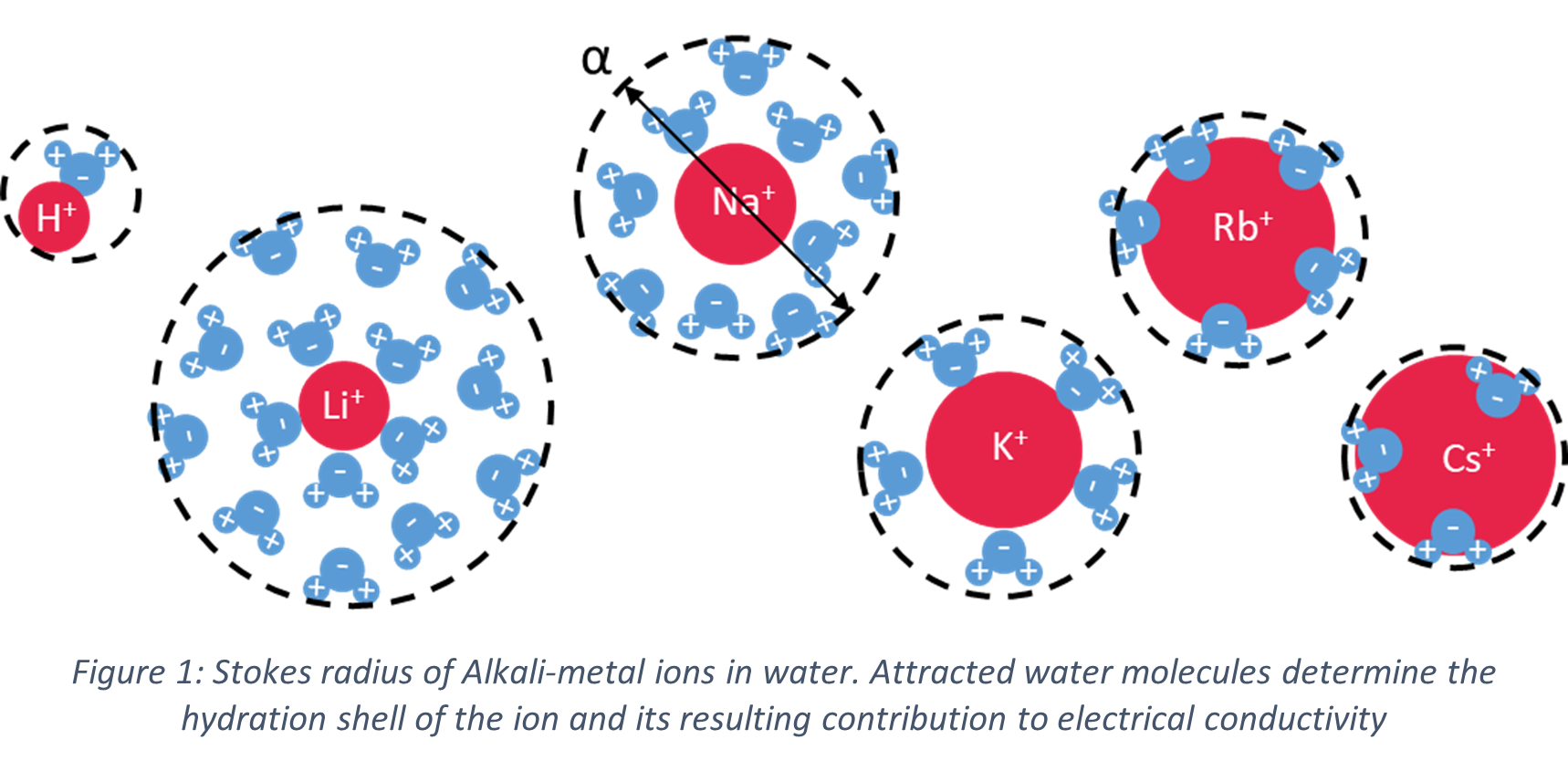

-
Solvent:
The solvent type determines the electrical conductivity of a solution as its degree of attraction influences the Stokes radius of an ion. Next to this, a solvent may also affect ionic mobility through its viscosity (Debye–Hückel–Onsager theory) where electrical conductivity is influenced by either increasing or decreasing the drag ions witness as they move through the solvent.
-
Temperature:
At higher temperatures, molecules and ions move faster. Therefore, generally, electrical conductivity of a given solution increases with temperature. To compare electrical conductivities a fixed measurement temperature is required (commonly 25°C). Temperature compensation can be derived from curves, yet can also be approximated by assuming a linear increase of conductivity versus temperature of typically 2% per kelvin
In practice electrical conductivity measurement is widespread for quick and easy determination of water quality and purity. For anti-freeze engine coolants, however, electrical conductivity measurement holds few value. As understood from the theory of electrical conductivity, every ionic additive or corrosion inhibitor ion has a different contribution to the electrical conductivity of the coolant. Given the complexity of additives and different neutralizing agents in coolants, electrical conductivity measurement can therefore not be used for compositional analysis, inhibitor content, or even an estimation thereof. Furthermore, the dilution rate or water/glycol ratio of a coolant also affects electrical conductivity. Higher water content causes higher electrical conductivities if additive concentration remains present. When diluting a coolant concentrate, this effect is partially off-set due to a reduction of additives (ions), yet still a coolant has typically a maximal electrical conductivity at 30/70 v/v ratio of water and glycol (Figure 2).
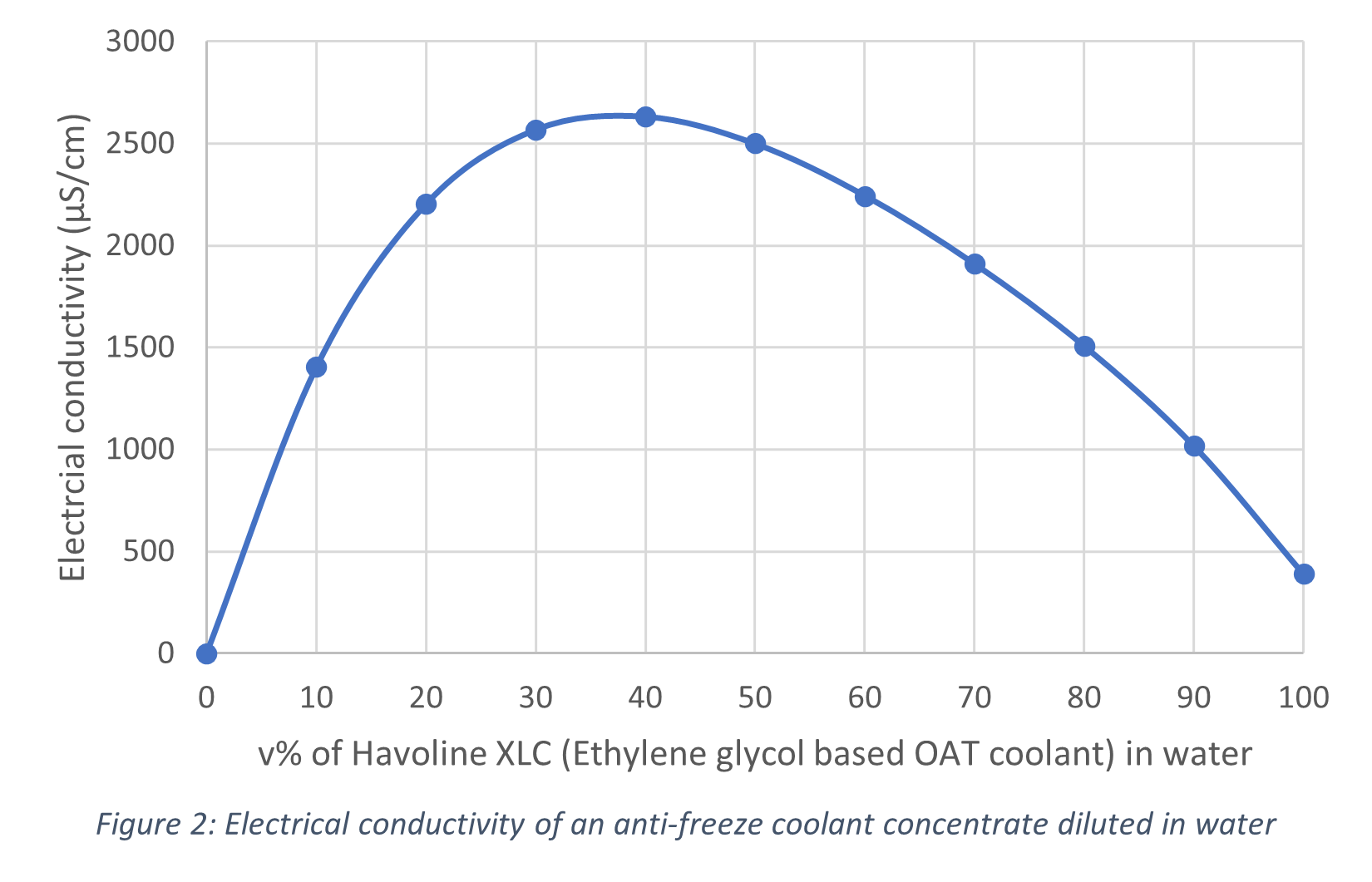
With the rise of electric vehicles (EVs), electrical conductivity of coolants was recently put in the spotlights. Today’s engine coolants, successfully used as thermal management fluid in EVs, have a drawback of high electrical conductivity, typically 1500 – 8000 µS/cm, depending on the technology, as 50v% dilution in water. With such conductivities, the coolant needs to be physically separated from the electronic components that require cooling (hampering thermal efficiency) and leakage is considered safety critical.
Therefore, a clear trend is witnessed to reduce electrical conductivities to lower levels, without jeopardizing the coolant’s heat transfer and corrosion protection performance. For dedicated Battery EV coolants a target is to reduce electrical conductivity below 100µS/cm. The nascent fuel cell industry is requiring electrical conductivity levels that come even lower than the already-low levels for battery electric vehicles. For Fuel Cell EVs, electrical conductivity of the water-based coolant needs to be below 5µS/cm, as electrical components are cooled directly (requiring high electrical resistance of the coolant to avoid short-circuits). Such dedicated coolants, with focus on electrical conductivity, are covered by our FREECOR® EV range.
Discover FREECOR® EV Milli coolants for BEVs Explore FREECOR® EV Micro 10 for FCEVs